article · Outdoor living, considered
Pool deck drainage: coordinate the deck and pool edge
Managing water on and around a pool deck, including slope, deck drains, coping details, and overflow protection.
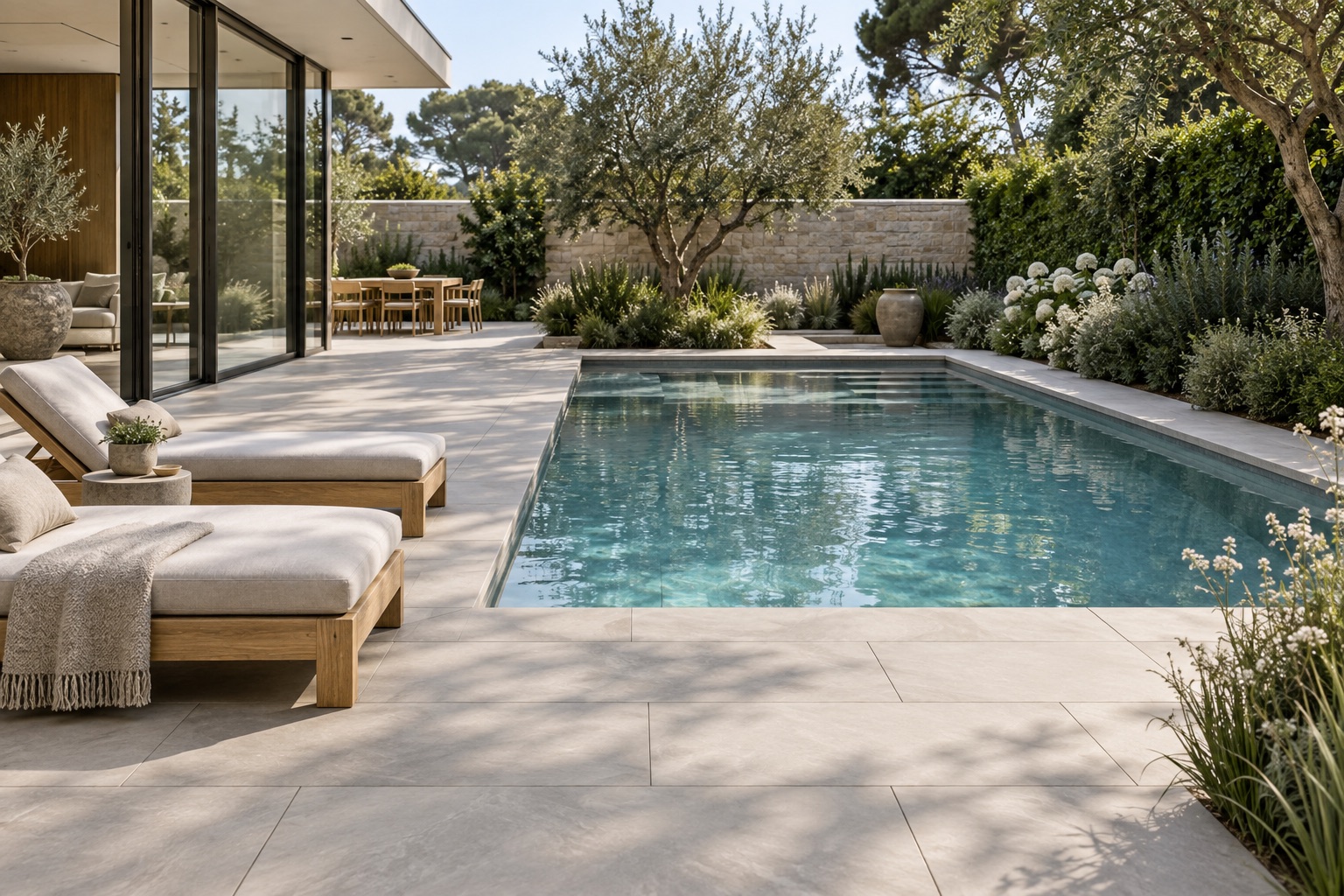
Water has to leave the deck
A pool deck receives water from splash, overflow, rain, and cleaning. If that water cannot leave quickly, it can pond, stain the surface, undermine joints, and work its way into places it should not be. Drainage is designed into the deck's slope and outlets; it is not an afterthought. The goal is to move water away from the pool, the house, and any structures, while keeping the deck safe to walk on.
Ask how the deck is sloped and where the water goes. Ask what happens during a heavy rain and during backwashing or overflow. Ask how the drainage design accounts for the pool's own overflow system and for the surrounding grade.
Slope around the pool
Pool decks are typically designed to shed water away from the pool and toward drains or the surrounding grade. The slope must be consistent enough to prevent low spots but gentle enough to be comfortable and safe. Because the slope is built into the base, errors are difficult to correct later. On decks around a fixed pool shell, the coping and waterline details also influence how water is shed.
Ask how slope was selected and verified, and how it interacts with the coping and the surrounding surfaces. Ask how the deck handles the transition to planting beds, lawns, and any retaining walls. Water that leaves the deck should have a defined destination rather than collecting at the edge.
Deck drains and channels
Where slope alone cannot move water, deck drains or channels may be used. These require planning for location, capacity, and maintenance. A drain that clogs or is inaccessible can cause the very problems it was meant to prevent. Ask where drains or channels are located, how they are sized, and how they will be cleaned.
Ask how the drain connects to the site drainage system and whether that system can handle the flow. Ask what happens if the outlet is blocked or the ground is saturated. Drainage design should consider the worst realistic conditions, not just a typical rain.
Coping and the pool edge
The coping and the waterline are where the deck meets the pool. These details manage splash, allow for overflow, and provide a safe edge. Coping should drain away from the pool, be securely supported, and use materials and joints suited to constant water exposure. The joint between coping and deck, and between coping and the pool shell, must be detailed to accommodate movement.
Ask how the coping is supported and restrained, how it drains, and how the joints are sealed. Ask how the pool shell and deck are isolated from each other if they move differently. Waterline tile and any automatic overflow system should be coordinated with the coping detail.
Drainage around the pool area
Beyond the deck, the surrounding landscape and hardscape affect water. Grade should fall away from the pool area, and any retaining walls should include drainage so they do not trap water. Downspouts and irrigation should be directed away from the deck. On sloped sites, surface water from above must be intercepted before it reaches the pool area.
Keep deck runoff out of unintended routes
EPA’s permeable-pavement guidance concerns stormwater assemblies, not a ready-made pool drainage detail. Use it to distinguish infiltration, storage and conveyance, then ask the pool and site designers how each applies here. Identify the destinations for runoff and cleaning water and check local discharge requirements. Surface water should follow an approved route; an open joint next to the pool does not, on its own, establish a functioning drainage solution.
Sources
- Stormwater best management practice: permeable pavements US Environmental Protection Agency