article · Outdoor living, considered
Pool coping and deck joints: decide the interface early
Detailing the pool perimeter: coping support, movement joints, deck-to-shell transitions, and edge restraint.
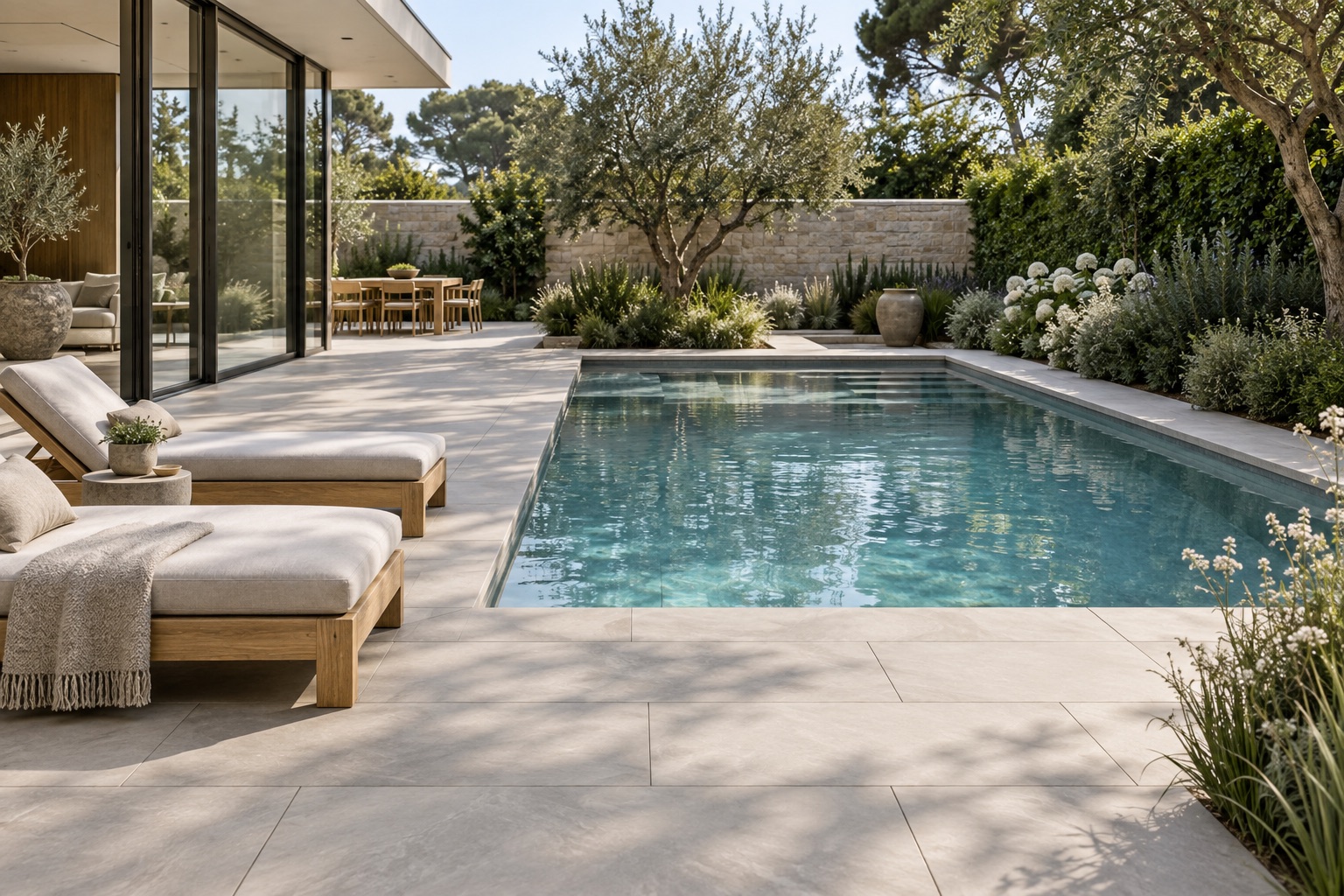
The pool perimeter does the hard work
The perimeter of a pool deck absorbs more movement and water than the field. The coping spans the gap between the deck and the shell, the waterline sees constant wetting and drying, and the deck edge must be restrained. These details are usually hidden or small, yet they decide whether the perimeter stays tight and safe.
Ask how the coping is supported, how it drains, and how it is restrained. Ask how the deck and shell are isolated so that they can move independently. Rigidly connecting materials with different movement behavior can contribute to damage, and repairs around a pool shell may be disruptive.
Movement joints and isolation
Movement joints let a deck accommodate expansion, contraction, and structural movement. They are needed at changes in plane, at the pool perimeter, where the deck meets the house or a wall, and sometimes within large fields. The exact layout depends on the system and the structure. Isolation joints separate the deck from elements it should not bond to.
Ask where movement and isolation joints are located and how they are detailed. Ask what fill material is used and how the joint will be kept functional. A joint that is pointed with rigid mortar or covered by a border defeats its purpose, so the detail must be visible in the layout drawing and respected during installation.
Coping choices and support
Coping is available in various materials and profiles, and it must suit the pool shell, the deck, and the climate. It should project and drain appropriately, provide a safe edge, and be supported so it does not rock or crack. The joint between coping and waterline tile, and between coping and deck, must accommodate movement and resist water intrusion.
Ask how the coping profile was selected and how it will be supported and bonded. Ask how it drains and how splash is managed. Ask how the coping will look and perform as it ages, and how a damaged piece would be replaced.
Edge restraint and safety
Where a deck meets the surrounding grade or a raised edge, restraint and safety details matter. Decks should not have unguarded drops, and edges should be stable and visible. Handrails, steps, and level changes should be planned with safety in mind, especially where the deck is used by children or older adults.
Ask how the deck edge is restrained and how steps and transitions are detailed. Ask whether the layout meets local safety requirements and whether a design professional should review it. Safety around water is a whole-design responsibility, not a surface attribute.
Check the edge as a walking transition
The selected paver installation detail should define its support and jointing requirements; it does not automatically define the pool coping assembly. The Access Board’s surface guidance also makes openings and changes in level relevant where an accessible route is required. Bring those concerns into one interface review. Inspect how the deck meets coping, where different structures can move, and whether a damaged edge can be repaired without disturbing the pool.