article · Materials, understood
Porcelain versus natural stone outdoors
How porcelain pavers and natural stone differ in uniformity, finish, maintenance, and design intent, and why the comparison belongs at the product level.
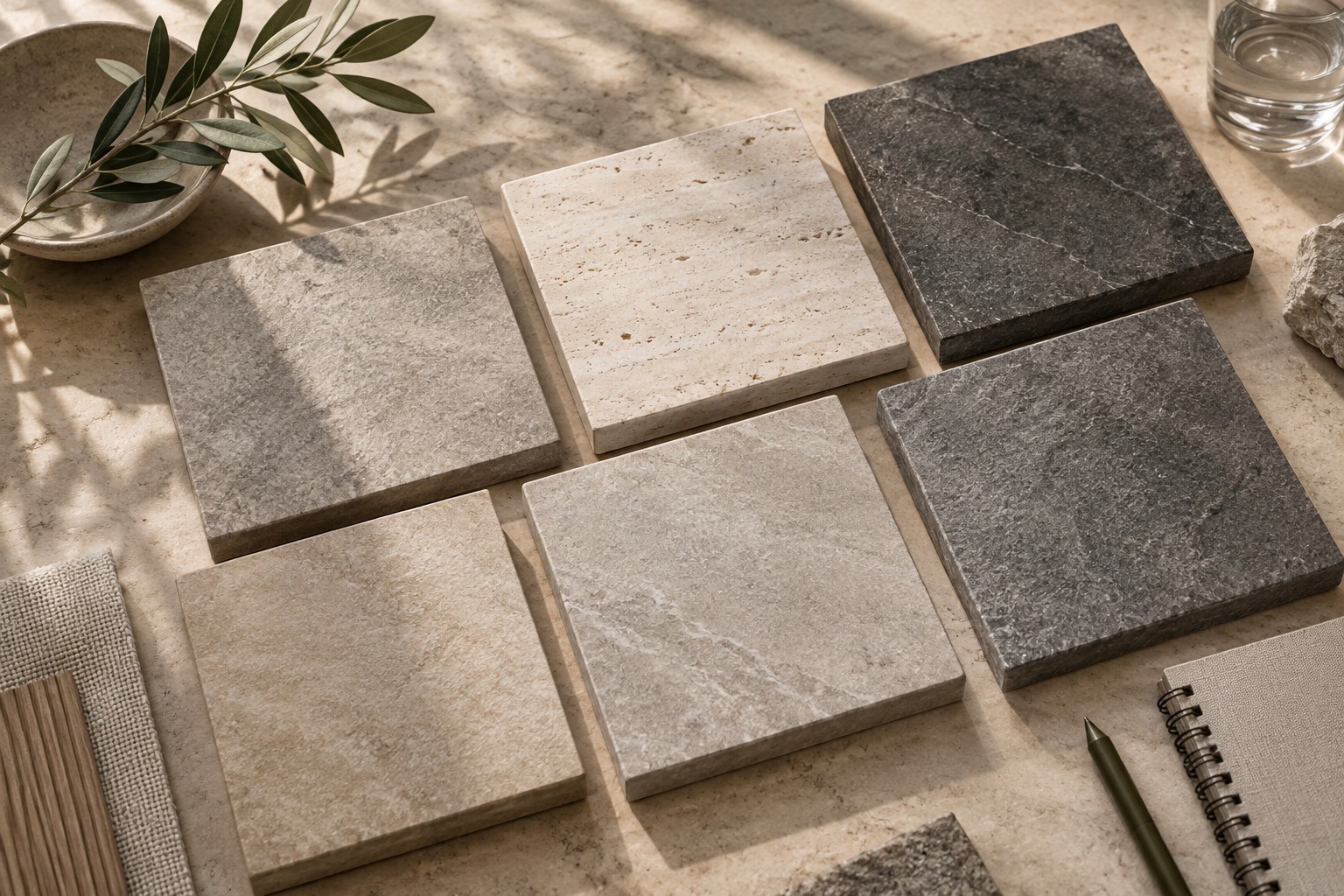
Two different ideas of beauty
Porcelain and natural stone are often compared as if they were competing versions of the same thing. In practice they express different ideas. Manufactured porcelain aims for controlled, repeatable appearance, with color and texture that can be matched across a large project and replaced years later if the same line is available. Natural stone aims for geologic variation, where color movement, veining, and fossil detail are the point rather than a defect.
Neither idea is better. A homeowner who wants an even, contemporary field may prefer porcelain; a homeowner who wants a surface that looks quarried may prefer stone. The mistake is choosing one while expecting the other, then treating normal variation or normal uniformity as a flaw.
Uniformity, color, and batch variation
Manufactured products still vary between production runs, so even porcelain should be ordered with an allowance agreed from the layout and, where possible, from a single batch for a continuous field. Natural stone varies not only between types but within a single type and even within a single slab. Fabricators often lay out stone pieces before installation so that dramatic veining lands where it will be appreciated rather than in a corner.
Ask how the material is sold and sampled, whether a current physical sample represents the delivered lot, and how much overage the installer recommends for cuts, breaks, and future repairs. For stone, ask to see several pieces rather than one sample. For porcelain, ask how to keep field and accent pieces from the same batch.
Water, staining, and sealing questions
Both families are used outdoors around water, but their care differs by product. Dense porcelain generally resists water absorption, while natural stone varies widely in porosity and sensitivity to staining. Some stones are commonly sealed, some are not, and the correct answer depends on the stone and the sealer. Sealing is not a universal requirement, and an inappropriate sealer can change the look or create maintenance problems.
Ask the manufacturer or stone supplier what care is recommended for the exact material, what substances should be cleaned up promptly, and whether a penetrating sealer is advised for the application. Ask how the surface should be cleaned and what should never be used on it.
Thickness and installation systems
Exterior products come in a range of thicknesses intended for different setting methods. Thickness alone does not authorize a setting method: loose-laid, pedestal and adhered applications each require explicit product and system approval. The product datasheet and installation instructions define what is allowed; a thickness that suits a pedestrian patio may not suit a driveway or an elevated deck.
Ask the supplier to confirm the intended setting system for each product and application, including base requirements, joint width, and edge restraint. Ask whether the product is approved for the specific exposure, such as over a waterproofed structure, and what the manufacturer requires at that interface.
Where each tends to fit
Porcelain may suit a controlled appearance and available large formats, but replacement stock and approved thickness need confirmation. Natural stone tends to suit projects that value uniqueness, mass, and the character of a quarried surface. Both can work on patios, walkways, and pool surrounds when the right product and system are selected. Cost, availability, and local trade familiarity often decide the rest.
Compare the maintenance commitment
TCNA identifies porcelain by tested absorption, while the Natural Stone Institute organizes care around geological composition. Those are different kinds of evidence. Build a comparison sheet that records the actual finish, permitted use, cleaning limits and replacement plan. A generic stone-look photograph cannot answer those questions. Where a stone sample varies, approve a realistic range of pieces instead of treating one small sample as a uniform promise.
Sources
- Porcelain versus non-porcelain tile Tile Council of North America
- Care and cleaning of natural stone Natural Stone Institute