article · Outdoor living, considered
Choose a patio finish for everyday use
How to choose among concrete pavers, clay, porcelain, natural stone, and sintered slabs for a patio, based on use, climate, and care.
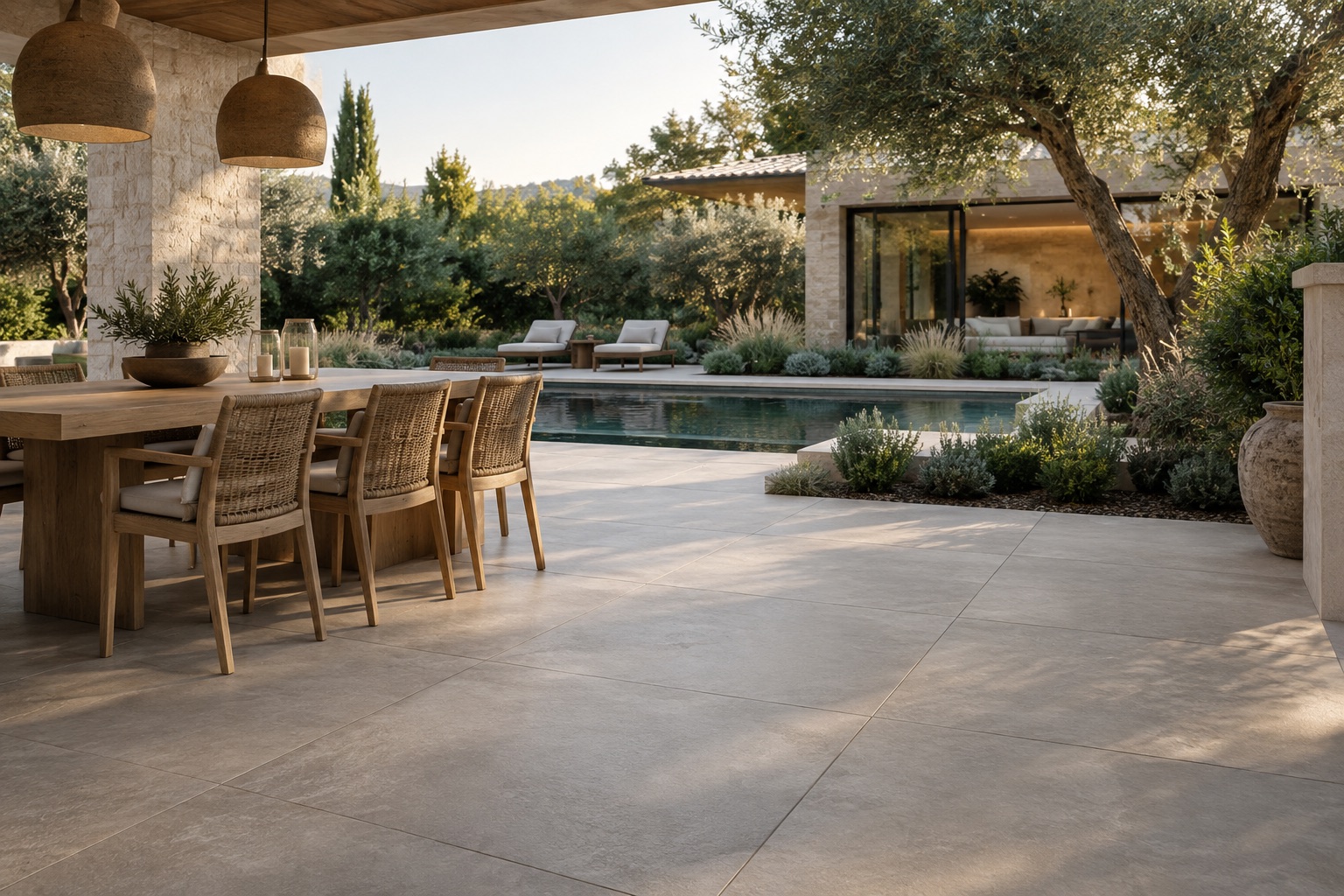
Match the surface to the patio's job
A patio surface has to handle foot traffic, furniture, weather, and whatever the household brings to it: grills, planters, fire features, toys, and pets. Some patios are quiet garden rooms; others are busy outdoor kitchens. The surface choice should follow from those uses, along with the base and setting method that the product requires.
Start by listing what the patio must tolerate and how much maintenance is realistic. A surface that needs sealing every year may be wrong for an owner who wants minimal care. A thin, large-format product may be wrong where the base cannot be built flat enough to support it. Fit matters more than category reputation.
Weigh material families
Concrete pavers are dimensionally consistent, widely available, and can often be reset individually if the base is sound. Clay pavers offer through-body color and a traditional look. Natural stone offers unique variation and a quarried appearance. Sintered stone slabs are used for large surfaces, cladding, and outdoor kitchen countertops.
Each family has internal range. Two porcelain products may differ in thickness, finish, and setting requirements. Compare specific products on the datasheet rather than judging the family. Ask which products are approved for the intended patio use and the local climate.
Think about comfort and safety
Barefoot comfort, heat retention, and texture matter on a patio. Some finishes feel cooler or warmer, some show footprints or water spots more readily, and some are more forgiving of bare feet than others. Texture affects how the surface feels and how it performs when wet, and it should be considered for steps and pool-adjacent areas in particular.
Slip performance is a combination of finish, water, slope, and footwear or tires. Ask for the manufacturer's published information for the exact finish and ask the installer how slope and drainage keep water off walking surfaces. Treat any claim about slip performance as something to verify with documentation, not a phrase on a sample tag.
Consider color, pattern, and light
Color and pattern set the character of the patio, but they also affect how it handles heat and how it looks over time. Compare the chosen colors under the site’s sun exposure rather than promising a particular surface temperature. Patterns such as running bond, herringbone, and large-format layouts have different cutting waste and different visual rhythms. Borders and bands can define spaces and manage edge cuts.
Ask for a layout drawing and, where possible, a dry-laid sample of the pattern using the actual product. A sample board shows color and texture but not scale or pattern. Seeing the material laid out in the field is the best way to catch a layout that does not suit the space.
Plan for care and repair
Ask what care the manufacturer requires, what cleaners are approved, and whether sealing is recommended for the application. Ask how a stained or damaged area would be repaired and whether matching material will be available. Systems that allow individual units to be lifted and reset are often easier to repair than large bonded surfaces, provided the base is sound.
Keep the product name, finish, and supplier record, and retain a small quantity of material for future repairs. A patio is a long-lived asset, and a little documentation at installation pays off years later.
Make comfort a sample decision
MSI’s heat discussion concerns its own pavers and comparable colors; it is not a universal temperature guarantee for every patio. Evaluate full-size samples in the site’s real exposure and consider shade and the times the space is used. Pair that comfort review with written care instructions. A finish that looks right in a showroom can still ask for more cleaning or different barefoot expectations than the household wants.
Sources
- Arterra porcelain paver applications and heat questions MSI
- Care and cleaning of natural stone Natural Stone Institute