article · Kitchen & bath surfaces
Porcelain versus natural stone inside the home
How porcelain and natural stone differ indoors in appearance, format, care, and installation, and how to choose between them.
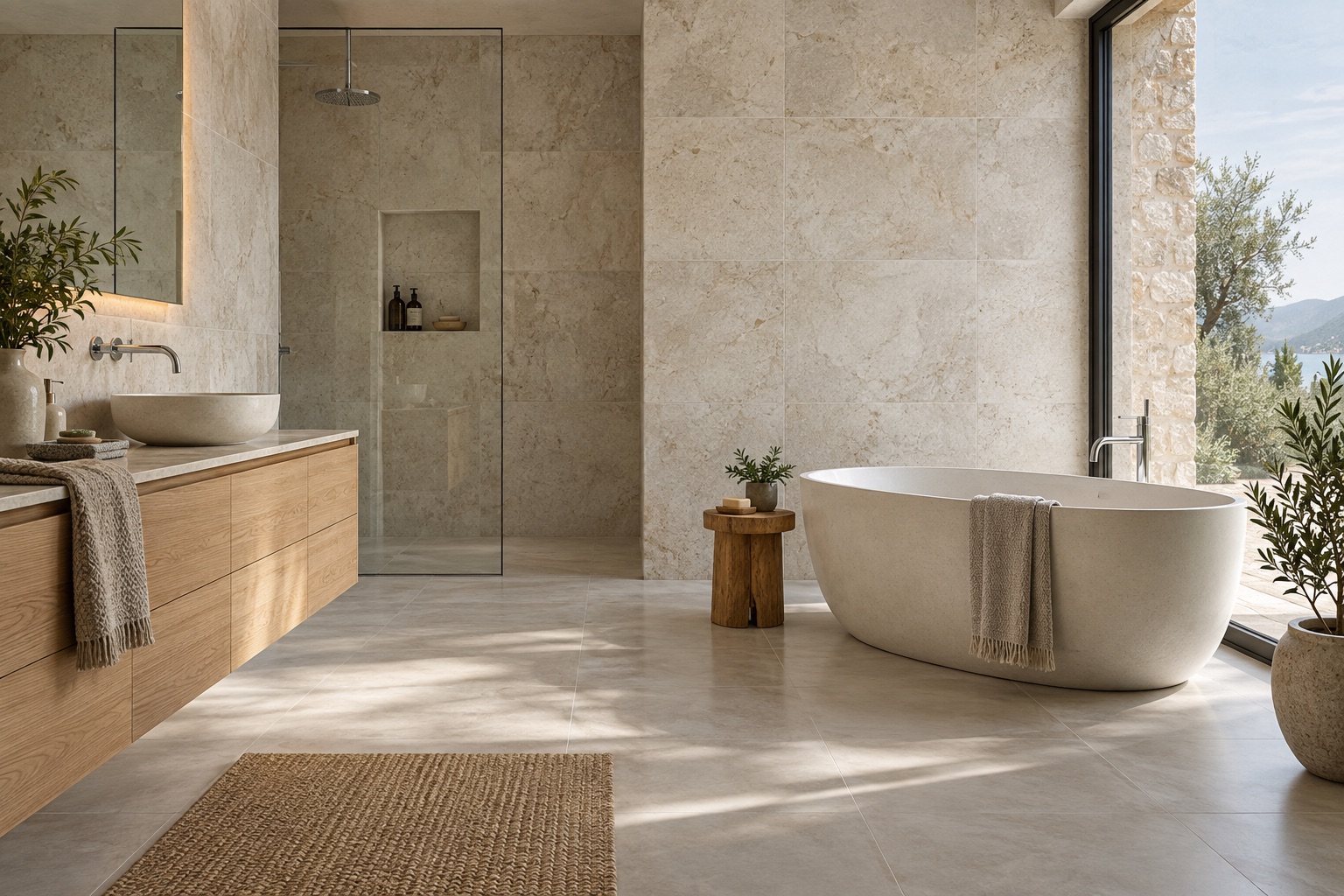
Two approaches to surface design
Porcelain is manufactured to be consistent and repeatable. It can reproduce the look of stone, concrete, or wood with tight color control and availability that must be confirmed for the order. Natural stone is formed geologically, so each slab and tile carries unique variation. The choice between them is partly practical and partly philosophical: do you want a surface that is uniform across a large space, or one whose character comes from its irregularity?
Neither is inherently better. Porcelain can create a visually continuous floor, but required joints remain part of the installation and future matching depends on product and batch availability. Natural stone can make a statement that no manufactured product replicates, and it can be repaired or re-polished in some cases. The right answer follows from the room, the budget, and the owner's tolerance for variation and maintenance.
Formats, thickness, and weight
Both porcelain and stone come in a range of formats, from small tiles to large slabs. Larger formats mean fewer grout lines and a more continuous look, but they require flatter substrates and more careful handling. Slabs used on walls or counters are heavier and may need specialized attachment and support. Thickness varies by product and application.
Ask what format suits the space and whether the substrate and structure can support it. Ask how the material will be cut, transported, and installed, and whether the installer has experience with that format. A large format chosen without those checks can create delays and breakage.
Finish and how it ages
Finish determines sheen, texture, and how the surface reflects light. Polished surfaces are glossy and reflective but can show smudges and may be slippery when wet. Honed and matte finishes are softer-looking and often preferred for floors and wet areas. Texture changes the surface feel; suitability for wet use still requires product-specific evidence. Natural stone finishes range from polished to brushed to split-face, each with different care needs.
Ask how the finish will look after use and cleaning. Some finishes show water spots or etch marks; others hide them. Ask whether the finish can be restored and how. In kitchens and baths, consider how the finish interacts with water, soap, and cleaning products.
Care and sealing
Porcelain is generally low-maintenance, but the manufacturer's guidance still governs cleaning products and methods. Natural stone varies widely: some stones are dense and easy to care for, while others are porous and stain-sensitive. Whether sealing is recommended depends on the stone and the application. Sealing is not a universal requirement, and the wrong sealer can change the look.
Ask for the care instructions for the exact material and finish. Ask which cleaners are approved and which should be avoided, and how to handle common spills such as oil, wine, and citrus. A realistic care plan makes maintenance expectations clearer.
Making the choice
Shortlist specific products in both families and compare them on the project's real constraints: format, finish, substrate, care, availability, and budget. Look at samples in the actual room lighting, and for stone, view several pieces. Consider how the material will meet adjacent surfaces at doorways and counters.
Ask what the material actually is
TCNA defines porcelain through tested absorption; the Natural Stone Institute describes quartzite as a geological material formed from sandstone. Neither label tells you every detail about a finish, slab or installed floor. Request the precise product or stone identification and examine more than one sample. Separate appearance, installation and daily care on the comparison sheet so a preference for visual consistency does not become an unsupported durability assumption.
A relevant supplier reference
NT Pavers’ interior catalog includes natural stone tiles, porcelain tiles and slab categories. It is a useful source for comparing available forms and finishes; the individual product documents still need to establish suitability for the intended room and assembly.
Sources
- Porcelain versus non-porcelain tile Tile Council of North America
- Sandstone and quartzite: identification and applications Natural Stone Institute
- NT Pavers interior tile and slab catalog NT Pavers